


01 October 2025
Unchartered Waters
Rakahinonga. Entrepreneur.
WRITER: As Told To Claire Williamson
photographer: Niki Boon
A sisterly nudge was what it took for Maegen Blom, 24, to apply for the 2025 Zanda McDonald Award. Here, the young leader recalls her pathway to becoming the operations manager of her family’s business – Mills Bay Mussels – and the first from the aquaculture industry to win the award.
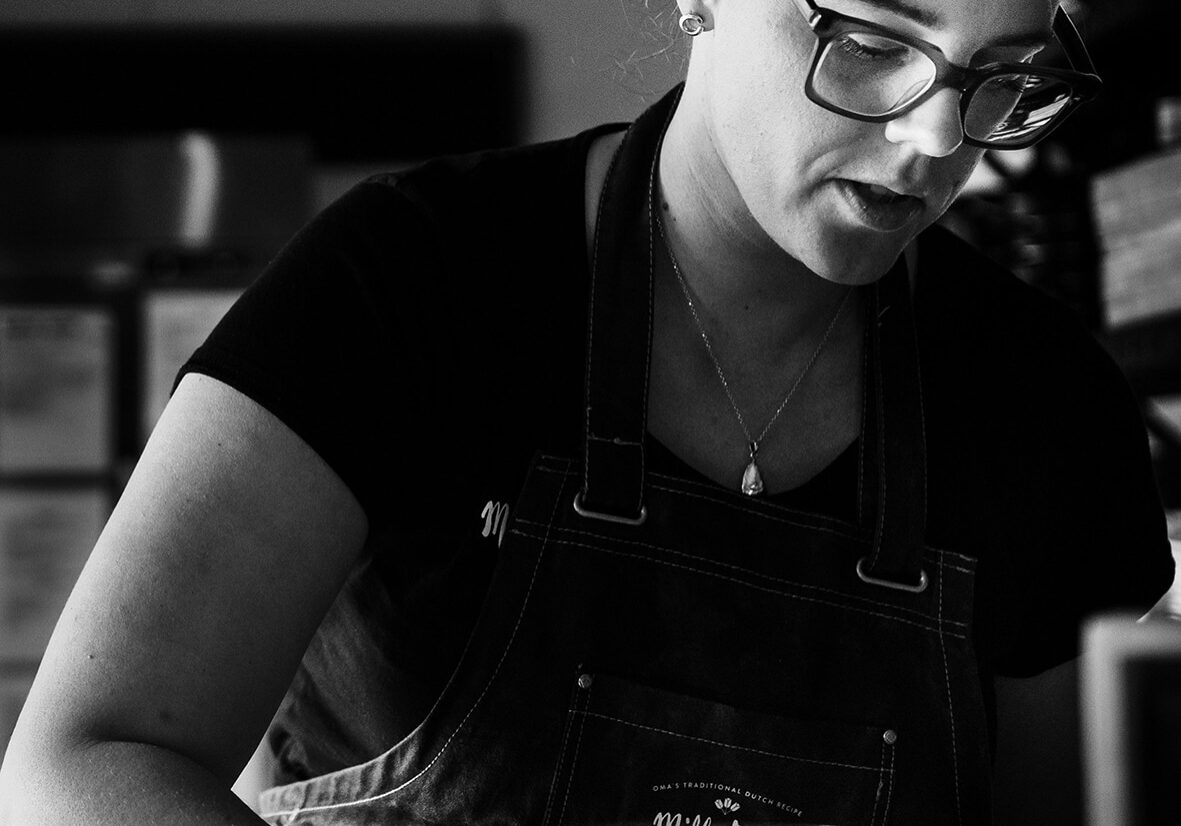
Top Image. “Mills Bay was one of the first mussel-growing areas when the very first mussels were starting to be commercially grown in the Sounds,” Maegen says. “It’s still a really productive area. When you go to Mills Bay, it’s really representative of the Marlborough Sounds.” Above. “One thing I’ve learned from my family is that work can be fun. I sort of had this mentality for ages that if you’re having fun, you’re not working hard enough, because ou’re not pushing your limits. But that’s not true – if you’re enjoying yourself, you do a way better job.”
I grew up in Southland, on a dairy farm down there. My favourite jobs were weighing calves with my dad and trimming tails, but I don’t have the same passion for cows as my brother and sister do. I guess I found a bit more of a passion in mussels. When I was fifteen, we moved to the Marlborough Sounds. It was an interesting experience, because I was at boarding school in Invercargill and then as a family we all moved out to a boat-access-only property. My parents like doing crazy things. They’re energetic people, and it shines through in their business mentality as well. They sort of see the world a little bit differently. They’re not scared to take risks, so uprooting the family is not out of character for how they did things.

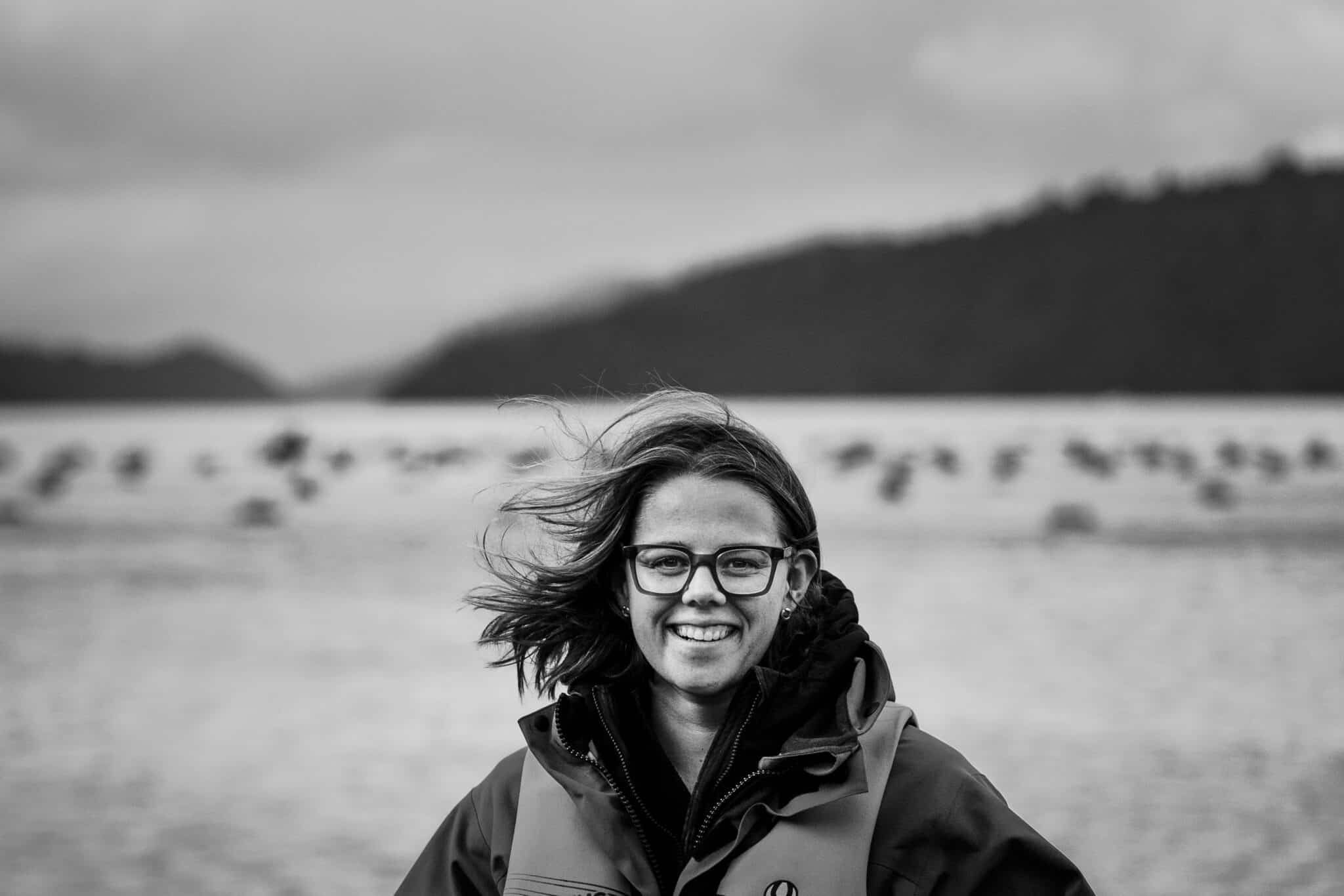
I feel at home in Marlborough now, but when I go to Southland that is my other home. I’ve sort of got a foot in both places. My Southland accent is disappearing, except when I get nervous, then it comes back really pronounced. And when I go back to the South it comes out again.
My parents wanted to diversify the farming business. Instead of just being dairy farming and commodity production – real price takers, where you don’t know what you’re going to get for your milk – they wanted to be a bit closer to the consumer. In Marlborough there’s dairy farming as well, but it’s not as optimal as Southland. But there’s quite a lot of opportunities in the mussel industry.
While we were living in the Sounds, we also got homeschooled. I could get a lot of my schoolwork done quite quickly and, at the time, my parents were buying this mussel distribution business. I found it quite intriguing, so they let me join all the negotiations and things like that. Then I just started picking up projects. Opening the Eatery was a big one.
“When choosing a pathway in life of what work I want to do, I feel like producing food is a noble profession. You’re feeding people – it’s a really important job – and that’s why I can get a lot of satisfaction out of it.”
It was a boarded-up, sort of obsolete factory area, so I unboarded the windows, got the builders in, got the designer in, and we opened up what’s now the Tasting Room & Eatery. We are seven or eight summers into that, now.
I ended up going back to school, but I had a good arrangement with my dean and she’d let me leave if I had to go and do certain jobs. Then I went to Wellington to study marketing, and I was going to live the “alty girl” lifestyle. But I realised it wasn’t for me – I’m a farm girl, so I wanted to find my way in food somehow. I was quite lost at this point through my uni years – we had Covid, then I was going to go to Europe and visit family over there – but it sort of all changed. I went to Lincoln uni and did the agribusiness food marketing course, which was cool because that set me up with a lot of industry connections.
After uni, I worked at Mills Bay and stepped into the operations manager role. Being a young manager, you sort of get in the deep end pretty quickly but it teaches you a lot of resilience and builds your confidence. I come into the business with more of a marketing angle. I see an opportunity for stories to be told and for things to be made a little bit more beautiful.
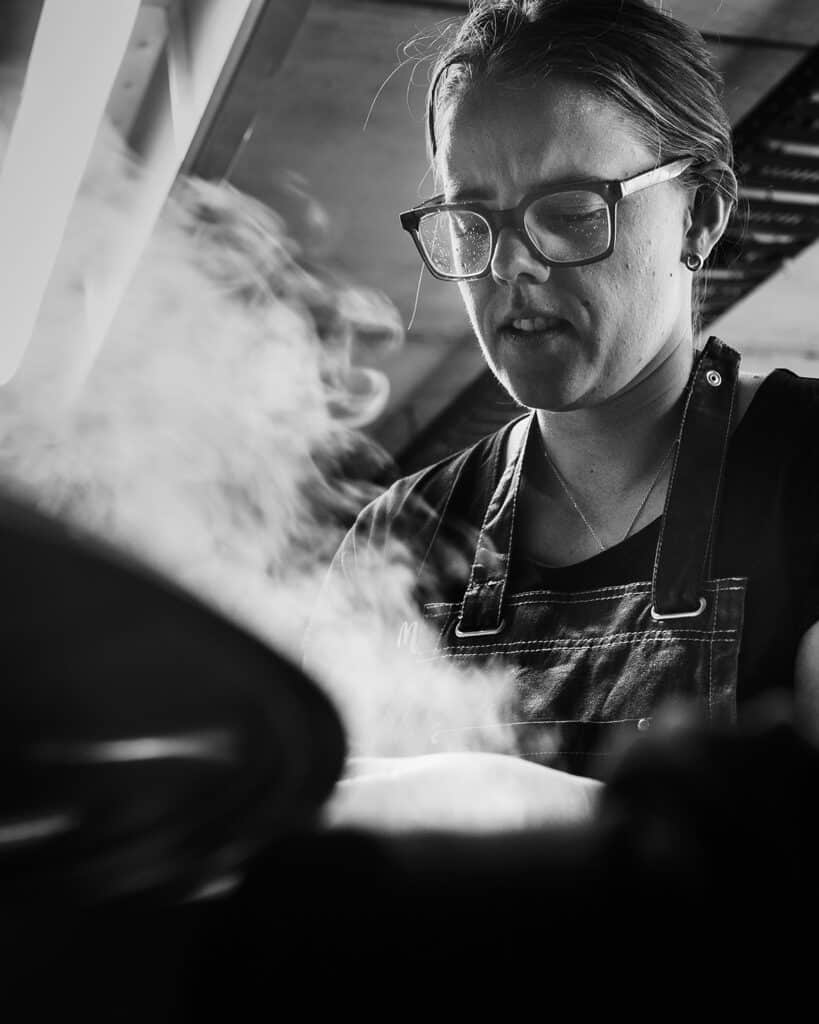
Left. “My parents are pretty clever, so it’s cool to learn from them. We’ve also found it important to get outside knowledge in – it does make the business stronger. We don’t know everything amongst ourselves, and then at those meetings that we have as well, we identify the gaps. You know, ‘Where are we? Where are we missing skills? Where are we stronger? Where are we not
as strong? And then who can we bring in to fill those gaps?’”
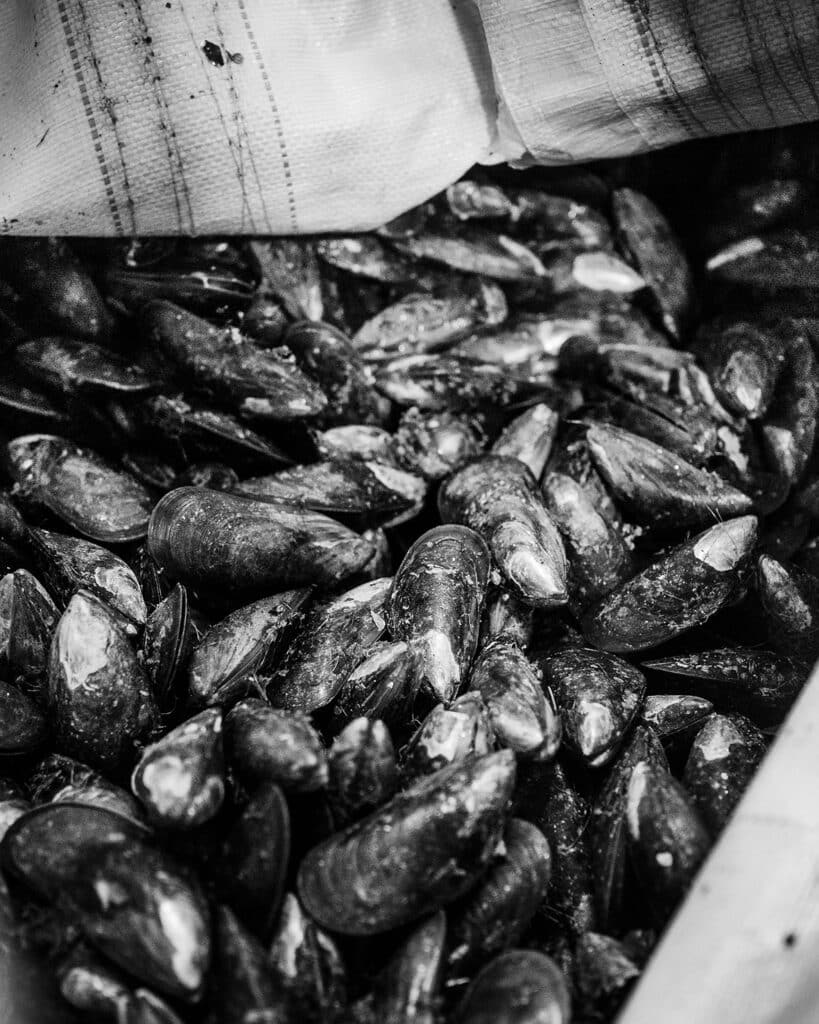
Right. “The ultimate dream is to make Mills Bay an iconic New Zealand food brand. I look up to Pic’s Peanut Butter – it’s likeone of my favorites, Lewis Road Creamery – just iconic New Zealand food brands, but with class. You should be able to eat mussels on a Wednesday night for dinner. It’s a treat, but it’s not like over the top – an affordable luxury.”
“I like beautifying things,” says Maegen. “That’s kind of how I see the world. When we do our family meetings, we talk about our values. And one of my values sounds superficial, but it’s beauty – not as in being beautiful yourself, but appreciating beauty. I feel that’s what I try to express with mussels.”
I love farming, but the reason I love farming is more the food aspect of it. Mussel farming is less about animals and stock and more about growing the mussels and then treating them as this delicious product. That post-harvest aspect was the most exciting part for me. Honestly, there’s blood, sweat and tears in the process. I walk around the supermarket and just get a little bit overwhelmed by the amount of work that’s going into everything. When someone can really enjoy it at the end, it’s like – that’s the treat.
My parents have built up a big part of the business, and they’re at this point where they’re keen to grow with us. Now they feel they’re going into uncharted waters and they’re keen to bring us on board. Our family working relationship is something we invest heavily in. We rely on open communication and making focus time to talk about things. With my siblings, we want to be part of the family unit, but also be able to do our own thing. I’m up here in Marlborough and my parents will come up every six weeks or so. But day to day, we don’t work together all the time. And my brother and his wife run one farm and contract milk – it’s the same thing, they run their own operation but are still part of the family unit.
Every six months we have a family meeting. A lot of it started out as succession planning, but also now it’s just turned into everything mixed together. We keep it light hearted. We always have something extra, like a costume or a wig or an accessory. The first time we went clown wigs. Next one, we were all Vikings. Next one, my mum bought us all ugly sweaters. The last one was at Easter, so we were Easter bunnies. You’re talking about something serious, and you might be on the verge of tears, and then you’ve got your little Easter bunny ears going. Everyone starts laughing!

“Ultimately, Mills Bay has to stay a total celebration of mussels. A big thing is setting ourselves up for sustainable growth. And I love it because it’s enjoyable. We’re just getting the mussel, putting the spotlight on it and showing it off for what it really is. That will never change – spreading happiness with delicious, healthy food.”
“I come into the business with more of a marketing angle. I see an opportunity for stories to be told and for things to be made a little bit more beautiful.”
I first heard about the Zanda McDonald Award from Doug Avery. He mentioned it to me when I was twenty one and said, “You need to apply.” And I was like, “No way!” because I’d seen the people who were winning the award. A couple years on I saw Doug, and Matt Hood, another guy from Marlborough, and they kept encouraging me, but I was like, “I don’t think I fit the bill.” After all of that, my sister said to me, “Maegen, the only reason they’re recommending it to you is because they think it suits you. So why don’t you just try.”
It took a lot for it to sink in that I won, because the other finalists were quite diverse and they’re all special people – pretty high energy, forward-thinking. That was the drawcard of the award. I’m excited to learn from people, and that’s the cool thing about the award. It’s not hot air. People walk the walk. It’s full of people with energy and vision who are young and want to make the industry better and support you in that. It feels quite selfless. I think it’ll show people who aren’t in traditional sheep and beef, arable, or dairy that they could also be part of the award, and then encourage them to put their hat in the ring.
I love mussels wholeheartedly, because they come from a really low-input farm source. We don’t feed them, we don’t fertilise them, we can’t drench them. You just have to really utilise the natural resource and work with it – because you can’t change it. You come out with this really nutrient-dense, delicious, healthy, native superfood. I’m genuinely proud to produce a product like that.
“In my day-to-day life, I look for people who give me inspiration, where we can bounce off each other, and I feel like the Zanda McDonald Award is just like, full of those people. So that was what’s so attractive about it. The interview process was really fun, and it challenged my thinking – I had to answer the interview questions, and it sort of makes you think, ‘Well, what is my answer?’”
Shepherdess is a proud media partner of the Zanda McDonald Award, which identifies and supports young leaders in Australia’s and New Zealand’s primary sector so they can learn, network, experience and grow. Applications are open between 1–31 October each year. To find out more visit zandamcdonaldaward.com.
If you enjoyed this story, please share with someone else.
This story appeared in the Kōanga Spring 2025 Edition of Shepherdess.
Get your hands on a copy.
Related Stories
A Cosy Spot
It’s a picturesque, sheltered cove with a wee fishing village that’s popular in the summer for swimming and holidaymaking, featuring views across the water towards Cathedral Rock and, further in
Roslein Wilkes
Roslein Wilkes MNZM, 85, reflects on her decades of volunteering with Marlborough Riding for the Disabled – which has not only benefited countless riders, but also helped Roslein through her
Sally Dryland
This story is the second in a series where we share, in their own words, the stories of ten women who call Tararua home.
Betting on Love
Atop a hill overlooking the rich and rugged terrains of Bendigo Station, Māniatoto Central Otago and beyond, Brenna Johnston and Patrick Heaney stood before their closest family and friends and