27 June 2026
Still on the Station
Rakahinonga. Entrepreneur.
Writer: Lauren Jackson
Photographer: Vivian Gehrmann
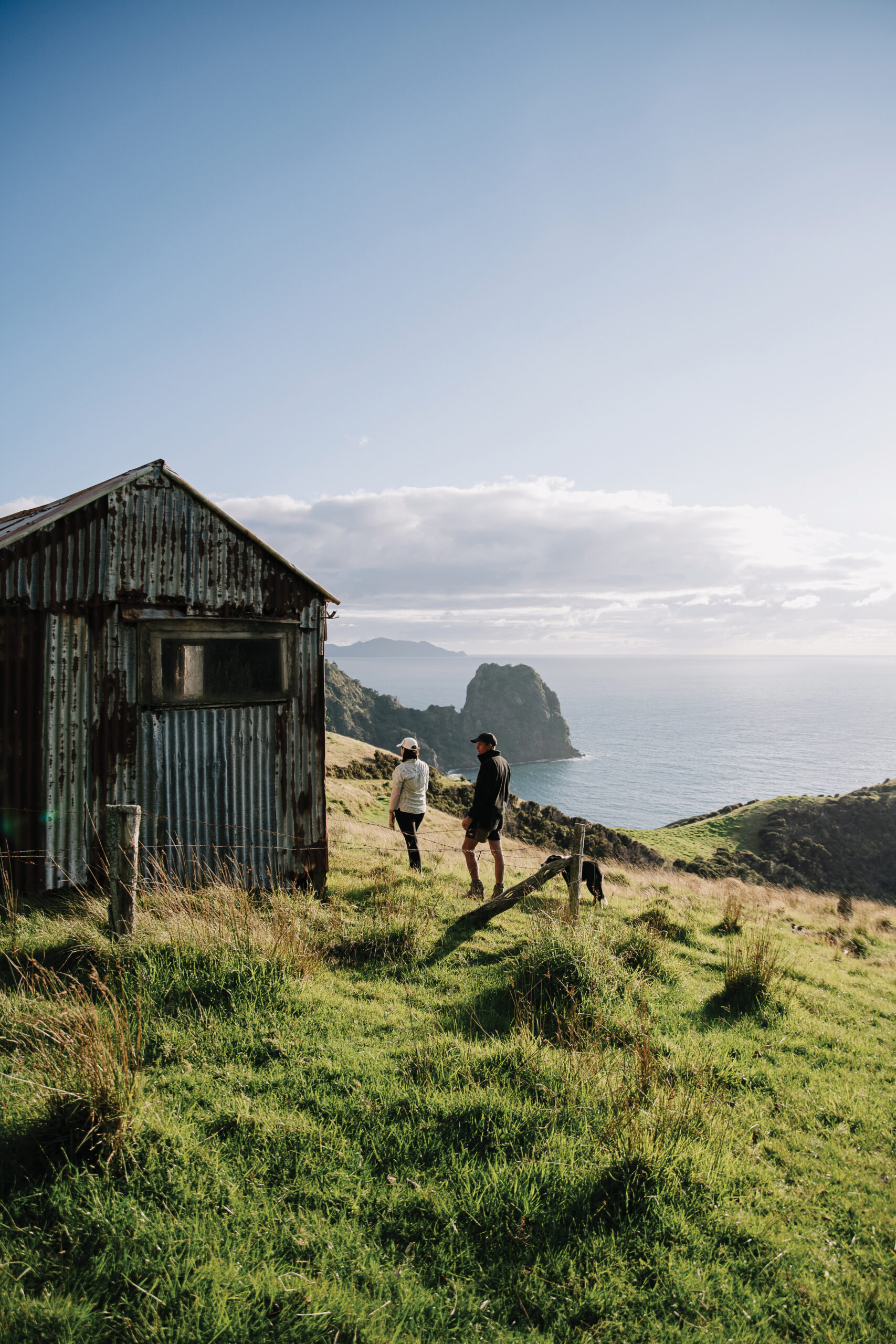
Cath Ward (Ngāti Raukawa) found a new purpose for both herself and Pahi Station when she and her husband, Zander, established the Pahi Coastal Walk – a private walk that takes in the farm’s sweeping coastline, rolling farmland and native bush.
With thanks to ASB for supporting the production of this story.
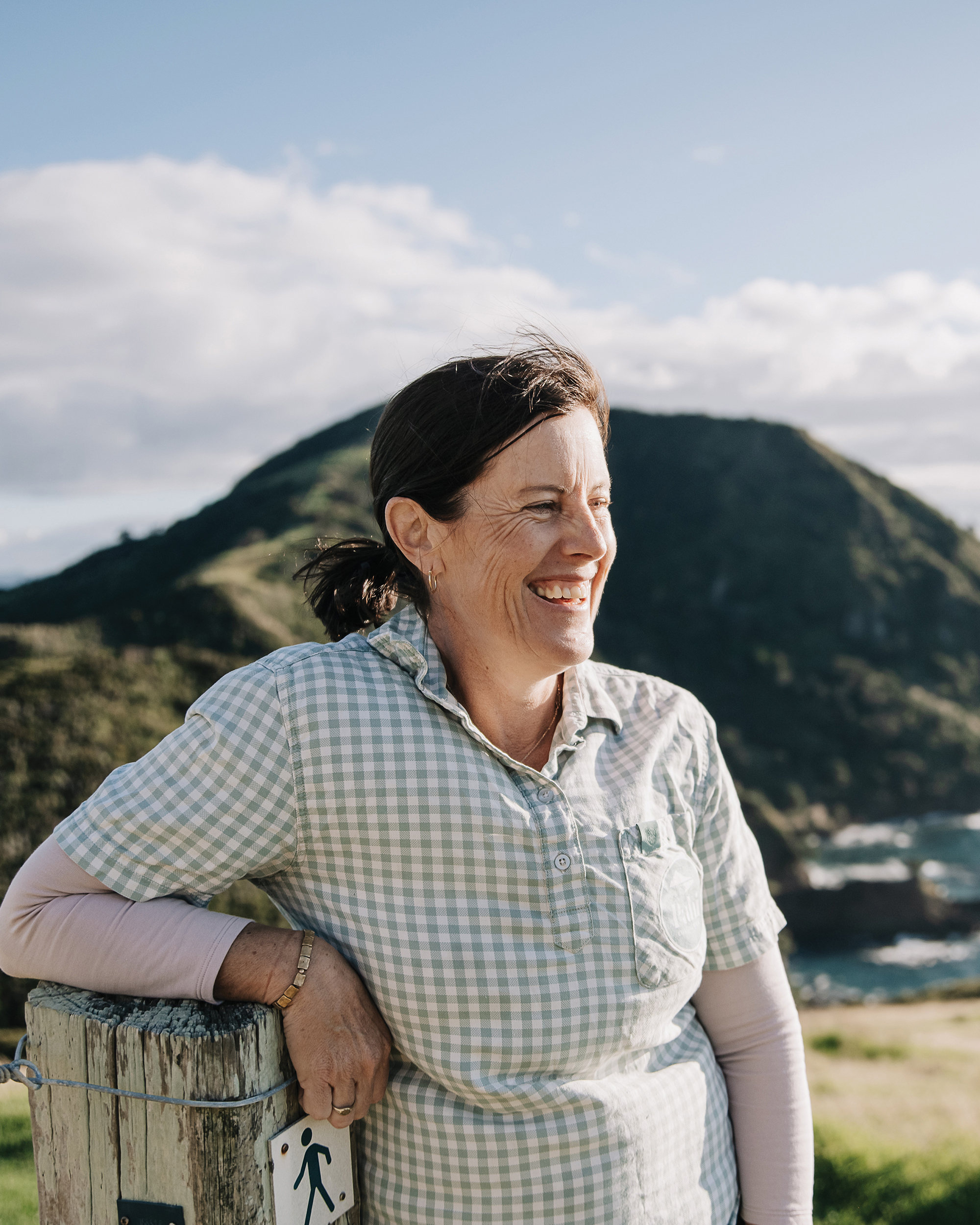
Cath Ward never expected she’d still be on Pahi Station at fifty. “I said I’d stay here until my first child was five.My first child’s about to turn twenty-two!” Cath laughs. She and Zander, 52, run a breeding operation and finish lambs and cattle on their 1,200-hectare station and a neighbouring 1,000-hectare block leased from Te Papa Atawhai Department of Conservation. And in 2022 the Wards opened the farm gate to welcome the public to the breathtaking Pahi Coastal Walk at the remote tip of Te Tara-o-te-ika-a-Māui Coromandel Peninsula at Port Jackson. The walk, which Cath describes as a “game-changer” for her, has booked out every season since it opened and earned her the Supreme Award at the 2024 NZI Rural Women Business Awards.
Cath and Zander first met through a mutual friend in London when they were each on their OE. Zander, the fifth generation of his family to farm in the Northern Coromandel since the 1880s, grew up on Pahi Station in the days when trips to town happened only twice a year.

Like Zander, Cath grew up on a farm – hers just outside Whangārei – and loved it. Unlike Zander, she didn’t plan to go farming. “I was going to have a corporate career,” says Cath, “but it became pretty evident that you can’t move a farm, and he wasn’t going to move.”
After travelling together, the couple returned to Aotearoa New Zealand in 2001 and started working on Pahi Station for Zander’s dad, Philip. Eventually, in 2007, they took over running the farm – which has grown from an original block purchased in 1931 by Zander’s granddad and his granddad’s two brothers. Having married in 2003, by the time they took over running the farm they had three young children, Kate, Harrison and Cameron. Cath loved the farm, but struggled with the isolation at times. Winters are very quiet. “We’re the community out here,” says Zander. “You’ve got to be reasonably self-reliant.” The nearest settlement, Colville, is forty-five minutes away by a windy gravel road that closes in bad weather. “When I was younger, I really missed my friends and that contact where you just go and have a coffee with someone,” Cath remembers.
With no school bus available, Cath and Zander initially rented a house in Colville as a second base before Cath opted instead to homeschool the children for four years. The farm gave the kids incredible freedom during those years. “They’d roam the hills, play and make games out on the beaches,” Cath says. Zander loved having the kids help out on the farm. “They learned to work and think for themselves,” he says. Later, the children went to boarding school in Kirikiriroa Hamilton. “They all really loved their sport,” Cath says. “We bought a place in Hamilton so we would go to the kids most weekends, as opposed to them coming home.” This was in keeping with their pragmatic approach to the farm’s isolation, which involves either driving over two hours to Thames for groceries or getting them from Kapanga Coromandel Town on the once-a-week delivery run. “Living in Port Jackson presents its challenges, so if we can somehow make it easier, we do,” says Cath. “We were the only people who had a holiday house in Hamilton,” she jokes. The couple still swears by getting time off the farm.
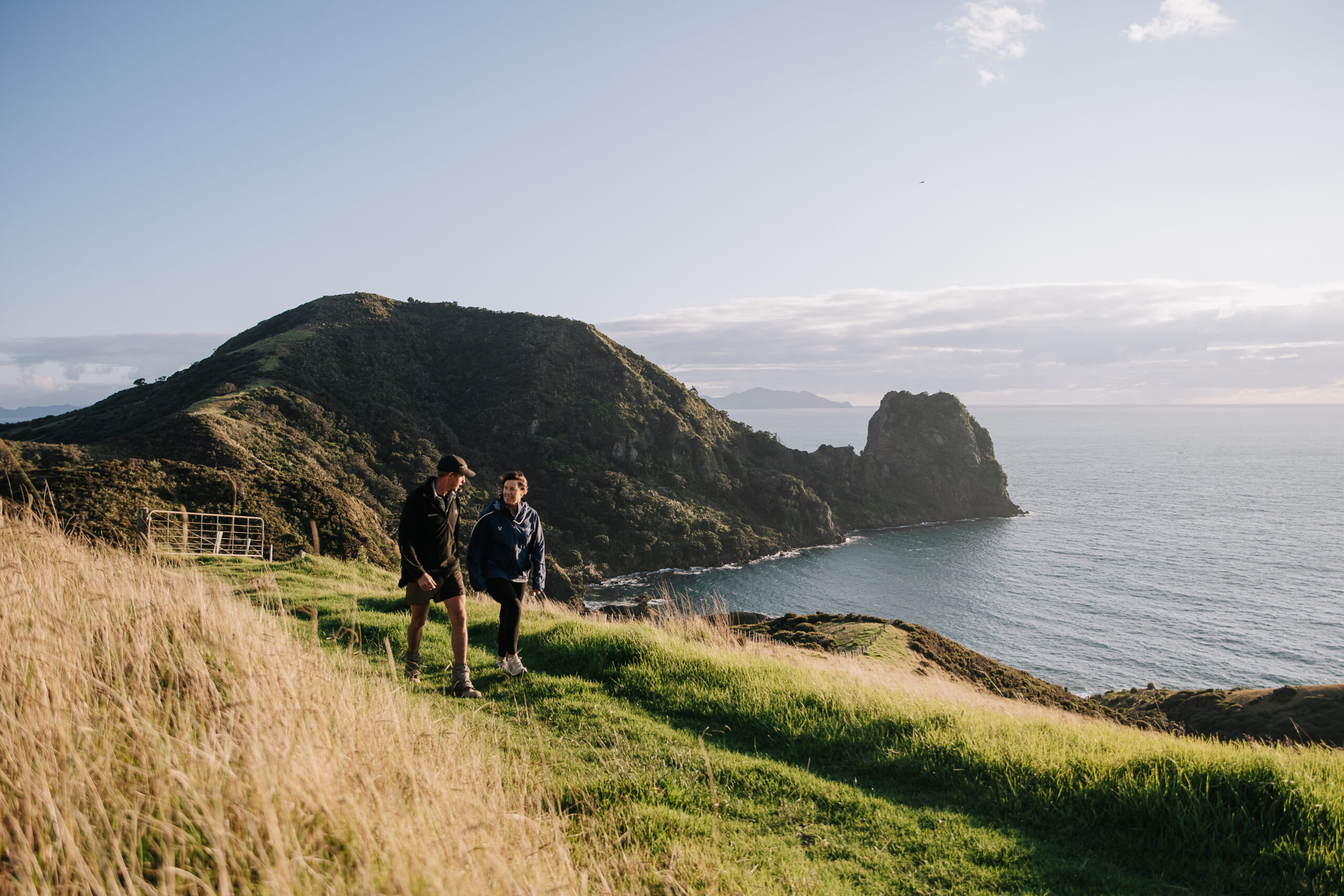
Above. Zander and Cath with the view to Aotea Great Barrier Island from the track. “It’s a beautiful place,” says Cath. “It’s got a good climate. There’s lots of recreation on our doorstep. The sea’s right there; there’s a river; and then there’s the farm – a great place to raise your children."
Find this story in our Takurua Winter Edition 2026.
As the kids headed off to university, Cath searched for anew purpose. She’d run a couple of Airbnbs on the farm, and considered a glamping business, but kept returning to the idea of a coastal walk. Other walks, like the Tora Coastal Walk, were thriving. Pahi Station certainly had the views and the scale. Zander was a little sceptical at first. He worried about how a walk might affect farming operations. Cath understood but was undeterred. “I ignored the critics, which is unlike me,” she says. “I just forged ahead.” Having done her research, she was confident to give it a go. “I put the virtual product out there before we did anything to the physical product. We could take bookings before we’d done anything on the ground,” Cath explains. “It actually worked out as a really good business model.”
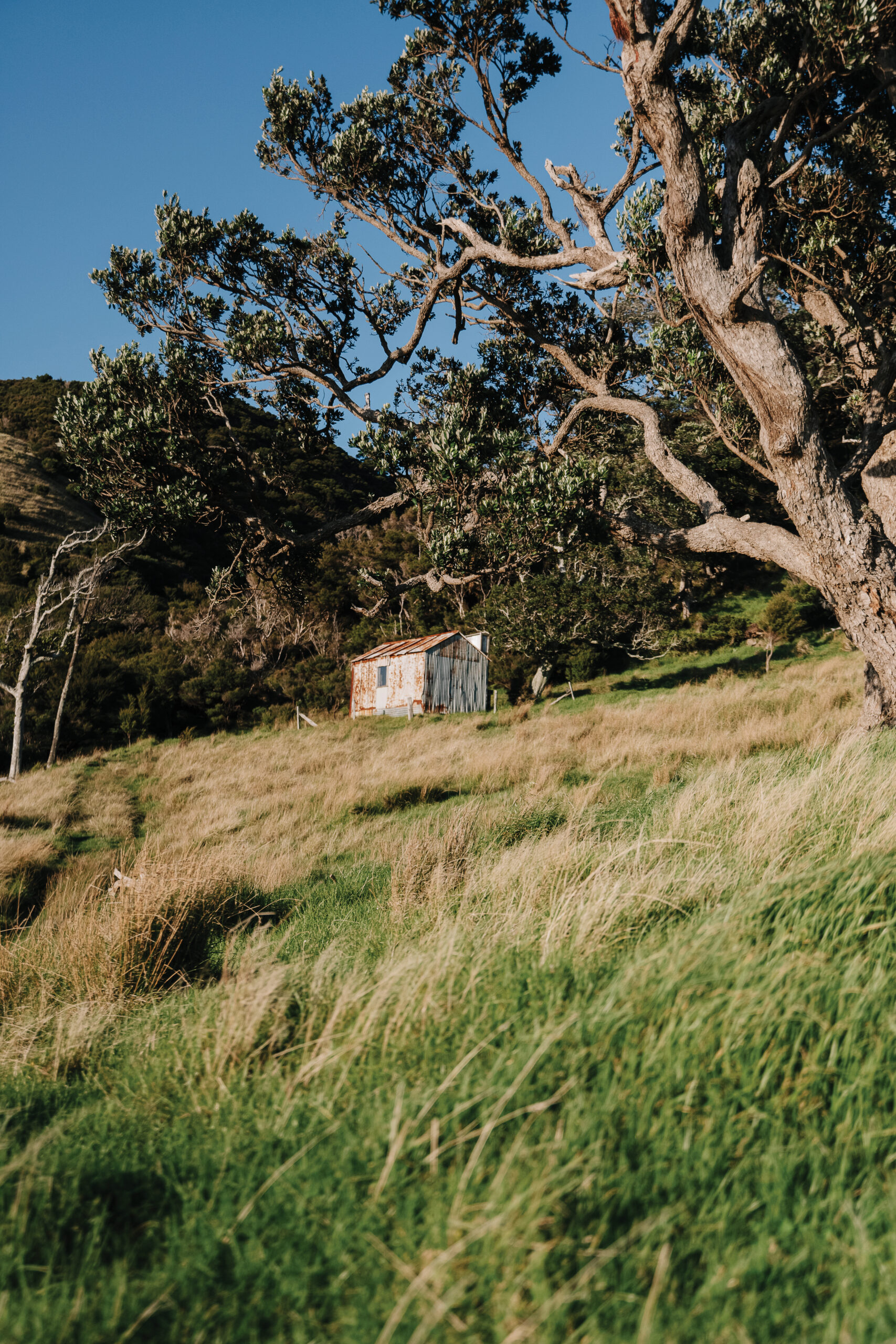
Cath and Zander spent the winter of 2022 preparing the grounds and tracks and transforming the two farm houses into the stylish Pahi Retreat and the Shearer’s Quarters. They’ve since added additional cabins, outdoor toilets, anda hot tub. The two-night, three-day walk circumnavigates the northern tip of the Coromandel Peninsula in a twenty-six to thirty-four kilometre loop, with easier walking options and e-bikes available.
In a twist of fate, the Pahi Coastal Walk opened just as Covid restrictions were being eased. “People were desperate for adventure,” Cath remembers. Word spread and the bookings came pouring in, but everything ground to a halt when Cyclone Gabrielle struck in February 2023. “We cancelled thirty-five days, where we physically could not get people in or out. The weather was just appalling, so to get through that year was an induction of fire,” Zander recalls. Regardless, the Wards hosted over 1,200 walkers that first season, from late September to early May. “It was certainly full-on,” says Zander.
Cath initially employed three local women and this has now expanded to seven. While Zander and his stock manager and shepherds take care of maintenance and development projects, Cath and her team run the walk. “It’s their gig,” says Zander. They transport the walkers’ packs and prepare all their food, freeing guests to unwind and spend quality time with each other. “Our whole operation is really systemised so it works really smoothly – the team works really well together,” says Cath. “We’ve gotten better and better.”
Income from the walk and a strong relationship with ASB have given Pahi Station a financial boost and enabled the Wards to invest in sustainability projects. Of their rural manager, Harriet Lawrence, Cath says, “She backs us.” When the couple met Harriet, they were hoping to buy a second farm and ease the number of stock they were running on the farm over winter. Cath and Zander purchased their second farm, Glen Murray, near Te Pūaha-o-Waikato Port Waikato in 2021. The different climate and geography of the two farms give Zander options when one coast is wet and the other is dry. “ASB made that happen for us,” says Cath. “That allowed us to be not as intensive here, and to fatten our stock over there, and in the long run it’s making more income. So then we can put that money back into the land and do some environmental initiatives – and the walk allows that as well.” It was important to the Wards that Harriet understood what they were all about, so they invited her and a friend to walk the Pahi Coastal Walk.
“She’s brilliant,” says Cath. “Harriet believes in us, and nothing’s a problem. I can phone her anytime and ask the dumbest question in the world – she’s never too busy.”
Cath and Zander have been able to participate in local environmental projects, including the Colville Harbour Care Project, a community-led project enhancing the health of the catchment, and Moehau ki te Moana, a recent five-year fencing and riparian planting project, investing alongside Waikato Regional Council and Manatū Mō Te Taiao Ministry for the Environment. Zander says, “It was a contribution both ways, from us and them.” Cath adds, “If you were just farming, these sorts of projects would be a real stretch. The diversification is assisting with getting some of these projects underway.” Cath and Zander have also been working with local iwi on riparian planting and pest control.
Zander’s initial concerns about the walk have proved unfounded. Cath describes the walk as “a great thing –it’s really non-impactful on the farming operation.” She explains, “Sometimes, Zander does need to arrange his day around where the walkers are going to be. Apart from that, it’s quite complementary to farming.” Although, she adds, “The shepherds have to watch their language!”
Walkers can expect a friendly chat when they meet Zander on Pahi Station, and Cath checks in on them each evening. “We just try to be ourselves and include them,” says Cath. “You want them to love your home, because we love it.” She sees how the walk transforms people. “They arrive at the meet and greet and they’re excited, but you can see they’re a little bit antsy,” says Cath. “Then I go and see them on their second night, and they’re just chilled and happy. Their ‘to do’ list has disappeared.”
The walk has brought more business to Colville and Coromandel Town, where most guests stay the night before they start the walk. On their way home, they tend to call in on local artists and often purchase their work. Cath describes this as “the flow on effect – people paying for accommodation, paying for their dinner in town and buying their lunch, that sort of thing. The Hereford and the Pickle, a cafe in Colville – most of our guests go there once or even twice.” For her, this has been an unexpected benefit of the walk. “I never really visualised that. I was probably too narrowly just trying to get it off the ground, but yeah, that was really cool. I was really stoked that that happened.”
Another benefit has been to the team of women Cath employs, who are all local apart from the two travellers they employed this season. “We’ve got a couple of local ladies who live down the road. It’s amazing for them because there’s no real employment up here for them. For the shepherds’ partners, it’s given them purpose up here as well. It’s allowed us to attract really good-quality people because we’ve got something for the wife and the husband.”
The walk provides an opportunity for local mothers to work in a remote location where there’s no childcare and they have no choice but to bring their children to work. “This season one of the shepherd’s partners – who has got two young children – will come and work when she can. Most afternoons, she’ll come and she can just work in the linen room. The children come to work with her. Her husband will take them home when he finishes work on the farm and feed them. Then she stays on for an hour or so. It’s actually quite nice for us to have the kids there because it gives us a distraction of the day too – we’ll take them on little chores, like if we have to go and feed the pigs.”
The work experience has also benefitted those who want to spread their wings. “A young local girl who grew up in Northern Coromandel and left school quite young, she came up here and at first she was petrified of the guests. We couldn’t even get her to drop the afternoon tea off in case she saw them. And by the end of it, she was doing debrief, which is where you go and see the guests at the end of the walk. She just grew in confidence. And she’s gone on to do Growing Future Farmers – we were her referees – because she always wanted to get into farming.”
“Every day we sit down and have lunch together,” says Cath of her team. With the Pahi Coastal Walk now bringing in over 2,000 visitors a year and employing a team of women who have become their own community, the isolation Cath once felt so keenly has dissipated. “The walk’s been a positive experience in every way,” says Cath. “It’s been good for the farm, for us as people, for the community, and for the guests. People contact isn’t an issue anymore. It’s given me full-time purpose and helped me feel settled here.”
Find this story in our Takurua Winter Edition 2026.
If you enjoyed this story, please share with someone else.
This story appeared in the Takurua Winter Edition 2026 of Shepherdess.
Get your hands on a copy.
Related Stories

Small Prophet, big reward: the Tokanui trio fostering creativity and community through their thriving business in a small town at the very bottom of New Zealand
Sarah, Ann and Sheila, each bringing their own expertise and creative passion, joined forces to form Small Prophet, a design studio at the edge of the world.

Adjusting to Alone
Michelle opens up about the feelings surrounding her solo Otago Central Rail Trail cycle trip and the scenery she documented along the way.