


25 February 2026
Courting Sustainability
Oranga. Ahuwhenua.
WRITER: FELICITY CONNELL
photographer: Vivian Gehrmann
Alice Trevelyan and Dave Swney are bringing fresh energy to their Te Awamutu dairy farm. With solar-powered milking sheds and a thriving native plant nursery, The Native Dairy Farmer, they’re growing a life that’s good for their family and gentle on the land.
With thanks to ASB for supporting the production of this story.
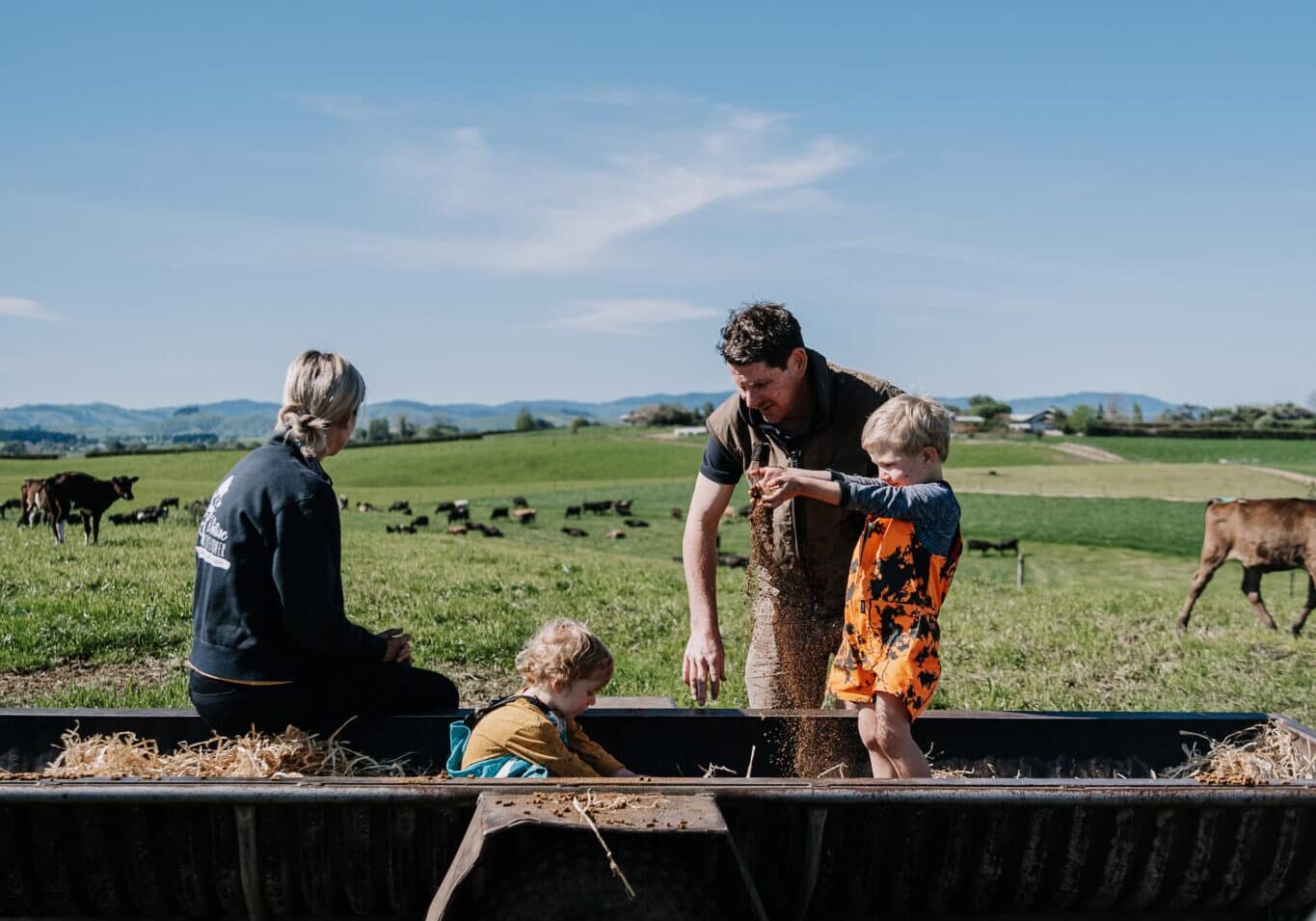
Top image. “I grew up on this current farm, so I guess you could say it’s in my bones, and it’s always been a love of mine,” says Dave. “I went away after school and university and did my own thing and then came back to the farm. The lure was a bit too great.” Above. Alice and Dave with Rex and Walter. “I’ve learned a lot of my farming skills off Mum and Dad,” says Dave, “and they’ve shaped us and the way we farm as well. They love the direction where the business is heading. Dad still helps out when he can, but he also loves sending me a text to say, ‘I’m glad I’m retired today,’ when it’s horizontal rain.”
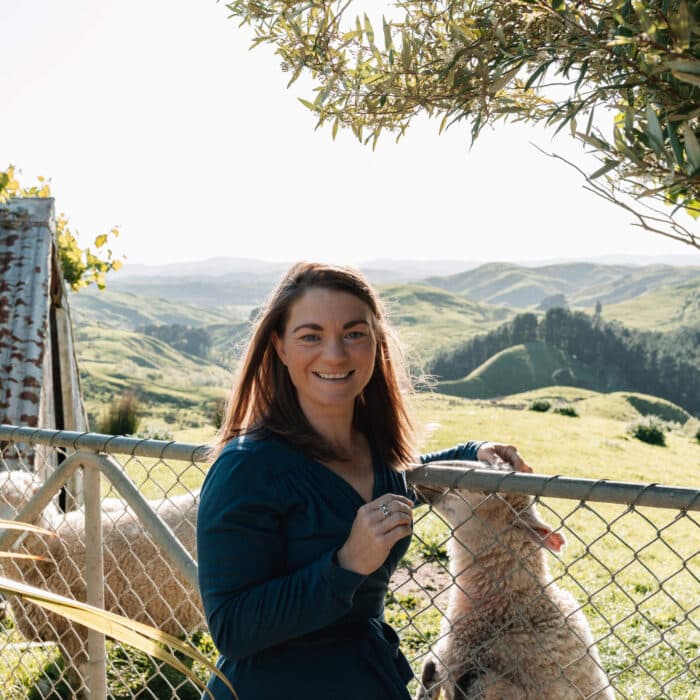
Set on gently rolling country, their 124-hectare farm looks out towards the bush-clad slopes of Maungatautari. Together Alice, 35, and Dave, 37, run the family farm in an equity partnership with Dave’s parents, milking around 400 cows and growing maize and chicory. Just over four years ago, they also gave new life to an underused space – an old tennis court – turning it into a thriving native plant nursery. “We didn’t set out to build a nursery in the middle of nowhere,” Dave says. “We’re very lucky. My dad and grandmother were very into natives too, and planted them on the property, so the nursery is surrounded by established natives and clients can see mature examples of the plants Alice is talking about.”

Alice’s family were farmers too – first in the United Kingdom, where she was born, and later in Upper Moutere, where they moved to run a sheep and beef farm when Alice was a teenager. However, farming wasn’t initially in her plans. At Ōtākou Otago she began training as a PE teacher, but a geography paper led her to a master’s degree in hydrology and into the environmental space – her true passion. A role with Waikato Regional Council brought her to Kirikiriroa Hamilton. “I was single and thought I’d give online dating a go. And then along came Dave, and no looking back,” she laughs.
The idea of a nursery on the tennis court was born when the couple began thinking about starting a family. “We were looking at ways where we could both work on the farm. At the regional council, I was advising farmers what to plant and where, and doing nursery inspections, as well as sourcing a lot of our friends’ plants. I think poor Dave thought I was a bit crazy because one day I came home from the hairdresser’s and was like, ‘Let’s start a nursery, let’s do a Facebook page.’ I had all these crazy ideas but, luckily, he said yes, and here we are, heading into our fifth potting-up season.”
For the pair, exploring solar for the farm felt like a natural extension of the values behind their native plant nursery – investing in ways that make the farm lighter on the land and stronger for the future. But understanding a whole new world of technology and terminology didn’t come easily. “I remember one meeting in particular,” Dave says. “My dad, Phil, and I just looked at each other blankly. We were like, ‘We’ve got no idea what you’ve just said – kilowatt this, inverters that.’ We came home and started Googling a few things so we didn’t look like muppets at the next meeting. But it’s been really cool. Now Alice and I find ourselves at night asking, ‘What did we export today?’ – and we actually know what it means.”
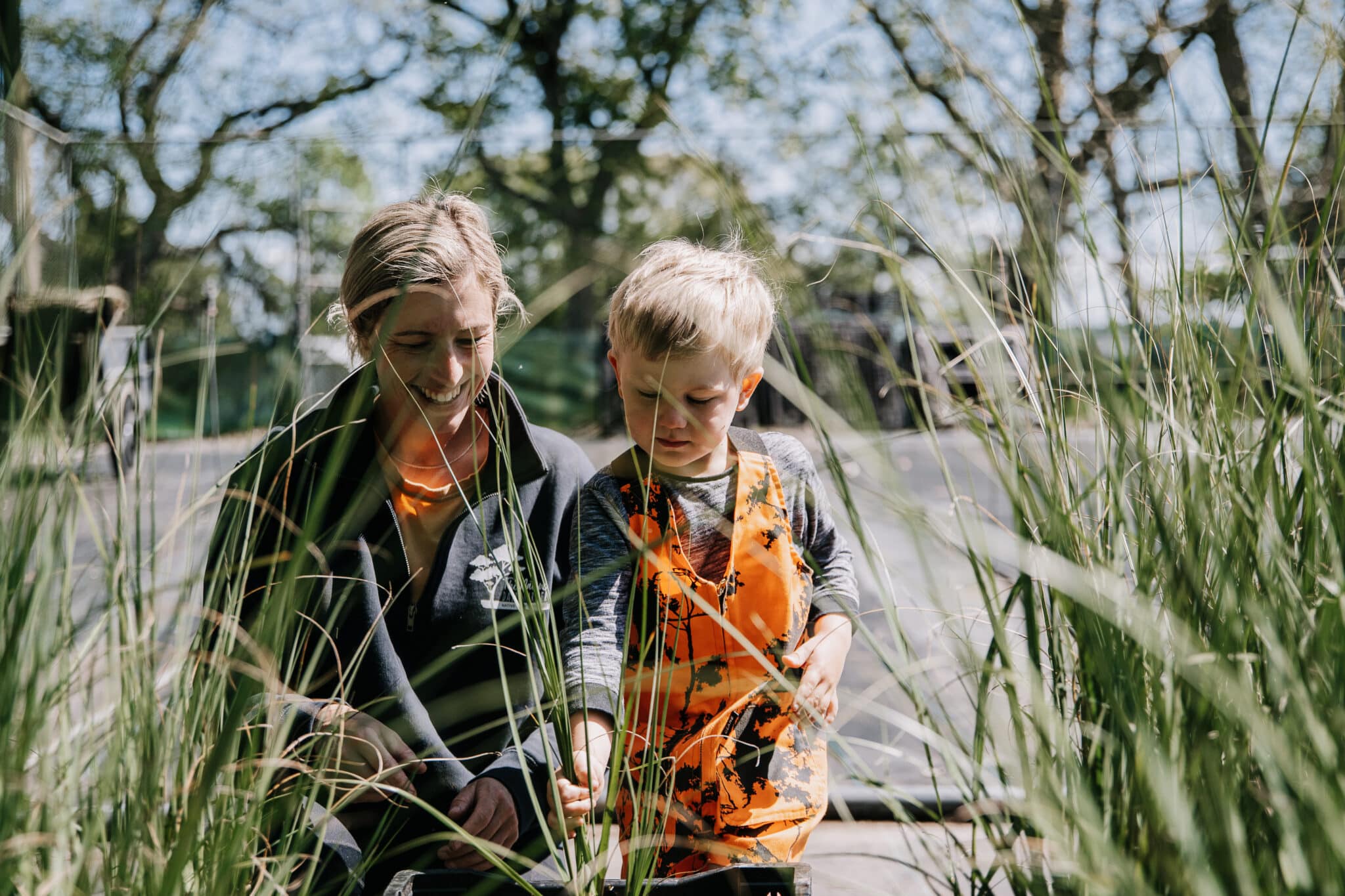
Above. “We are a little bit different,” says Alice. “We grow our plants in paper pots, so you can plant the whole thing straight in the ground. So, you don’t have any plastic pot or rubbish when you finish planting, which is great – and you get a beautiful root structure on your plant.”
Like many farmers, they’d always known electricity was a big farm cost. “We used to just pay the bill and not give it any thought, yet it was about $35,000 a year. That’s a huge amount of money to not know where it’s going. Now we can see how much power is being generated, how much goes back to the grid, and how much we’re actually using,” Dave says. That knowledge has shifted how they run the farm. “We know our effluent irrigator uses a lot of power,” Dave says. “It used to run automatically during milking, often when it was still dark. Now we’ve got a rule – it stays off until the sun comes up. We want to use that energy from the sun to power the machinery. It’s changing the way we farm and how we operate, which is pretty cool.”
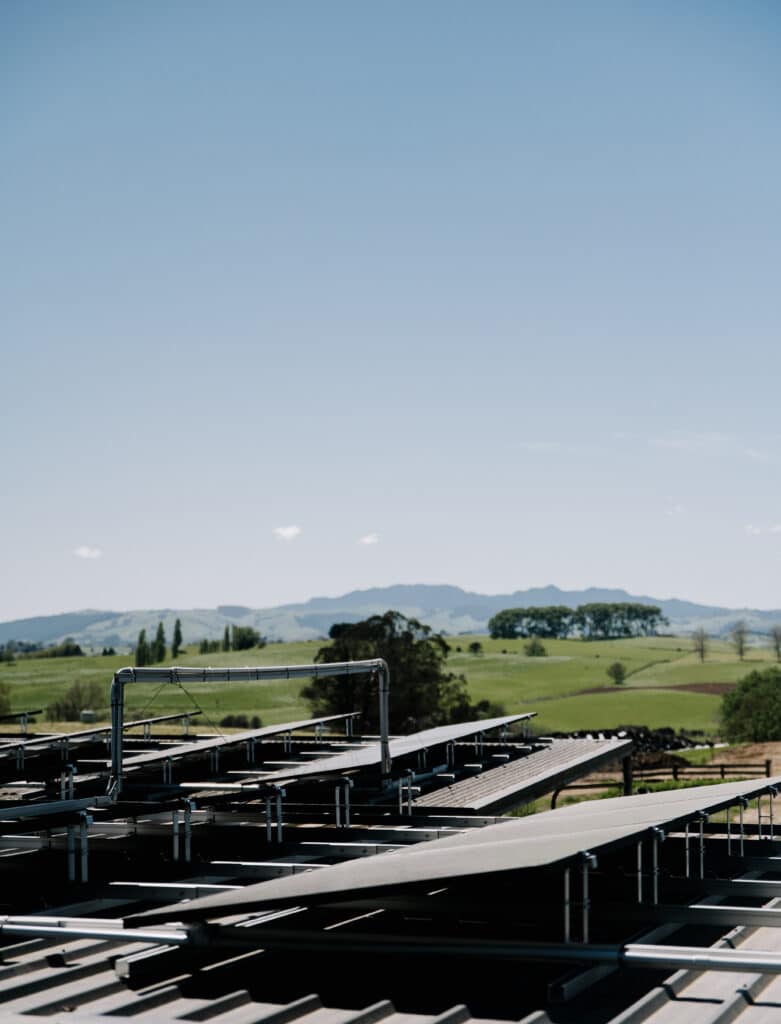
The idea to look at installing solar power for their milking sheds first took root after Fieldays a couple of years ago. “We were asking more questions about solar, looking at what our milk company was doing in that space. They put us in touch with Farmlands Flex. And support from others in the ag sector, like Farmlands and ASB, gave us reassurance that, hey, this can actually work,” Dave says. Although the system’s only been up and running a few months, the difference is already clear. “We’ve got the basic setup – no batteries yet – so any excess power we generate goes back into the grid,” Alice says. “We’re already noticing lower power bills. And we’ve got the app on our phones, so when the weather changes we have a sneaky look to see how our power’s tracking. It’s amazing to have that information at your fingertips.”
Hemi Kingi from ASB has been the Swney family’s rural manager for over five years,
and his support and advice has been integral to Alice and Dave’s expansion into the nursery, and now their foray into solar. For the solar installation, ASB provided Alice and Dave with a Business Sustainability Loan, then helped them into the zero-percent-interest Smart Solar Loan.
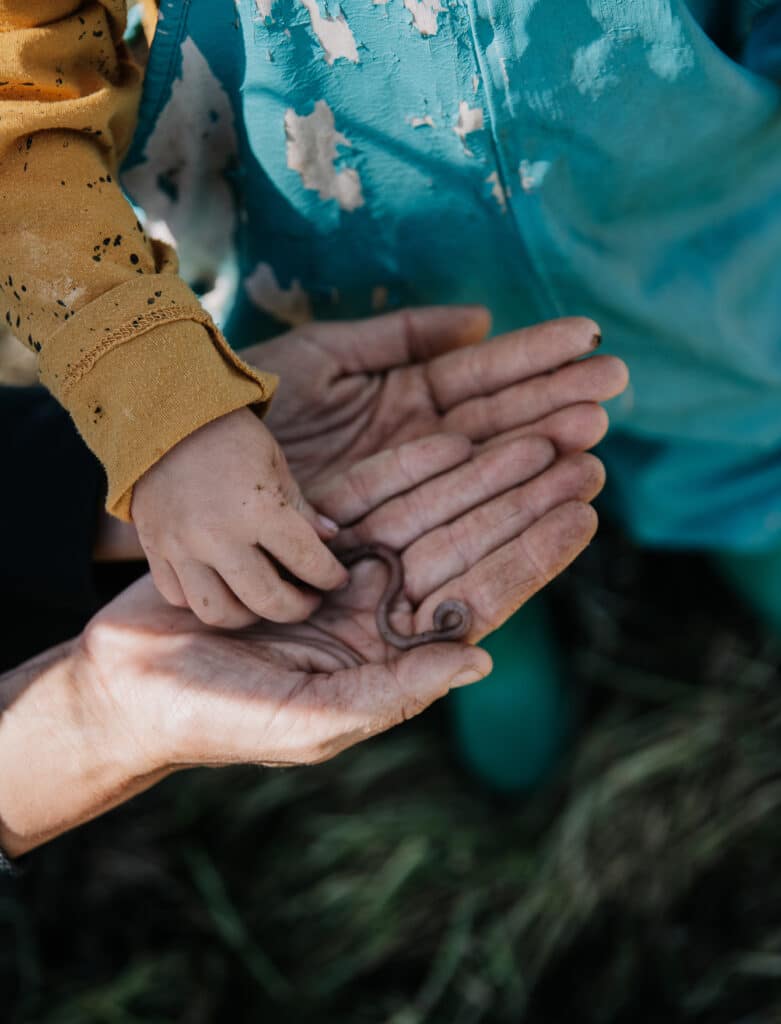
Left. Rex playing with worms. “Today, Rex had to go to the doctor, so Walter was coming with me down the farm. But it was an absolute war zone because poor old Rex didn’t want to go into town,” Dave says. Alice adds, “We had to wear our gumboots to the doctors’ as a compromise.”
Right. Solar panels on the roof of the cowshed. “I’d say the nursery complements the farm about sixty to seventy per cent in terms of work, but financially it’s huge,” says Dave. “As seasonal milk suppliers, there are months with no cheque and that’s when nursery income comes in. And when nursery expenses ramp up, milk money starts flowing again – so the two balance each other really well.”
“Hemi really understands our family, our business, and what we’re trying to achieve. We know we can call him with any questions, and he’s always supportive. That’s been especially important with succession – having an older generation and us as the younger one, there are lots of moving parts. Hemi’s been a great balance in that space. He can see the value in what we’re trying to do, and he backs us in it,” Dave says. “I say it a bit cheekily – because we obviously pay interest rates – but people like your bank manager and other rural professionals have a specialised skillset. You don’t get an invoice every time you ring them or they visit the farm. As a business, we’ve always tried to make the most of those opportunities. With Hemi, we know how lucky we are to have that kind of support at our fingertips.”
While Alice takes the lead on the nursery, both she and Dave juggle work across the farm and nursery. “The nursery’s about to go into a really busy stage potting up for next year’s plants, and at the same time Dave will be flat out managing mating and cropping,” Alice says. “Sometimes we’re running in opposite directions, but by May and June things ease off on the farm so Dave can help in the nursery. And whenever we can, we both chip away at the weeding.” Both sets of parents live nearby and often help with childcare. “Our parents are key to this whole thing,” Dave says. “They help with the kids and in the nursery. We’re really lucky to have such a strong support network.”
Diversification has also allowed both Alice and Dave to work on the farm together. “Having kids was a big thing for us, and we wanted to take them along for the ride,” Alice says. “Walter’s just turned three and he’s only just started kindy, so until now he’s been out there with us every day. Including the kids in our business has been important, but it’s also meant a mindset change. We have to be okay with what gets done in a day.” She admits paperwork often gets left until after bedtime. “I try to plan my day in bite-sized chunks now. Before kids, I could stay out all day and just keep going, but now I have to say, ‘I’ll pot plants for an hour, then take a break with the kids, and then come back to it.’ I’ve learned to be more realistic about what I can and can’t get done – and to ask for help.”
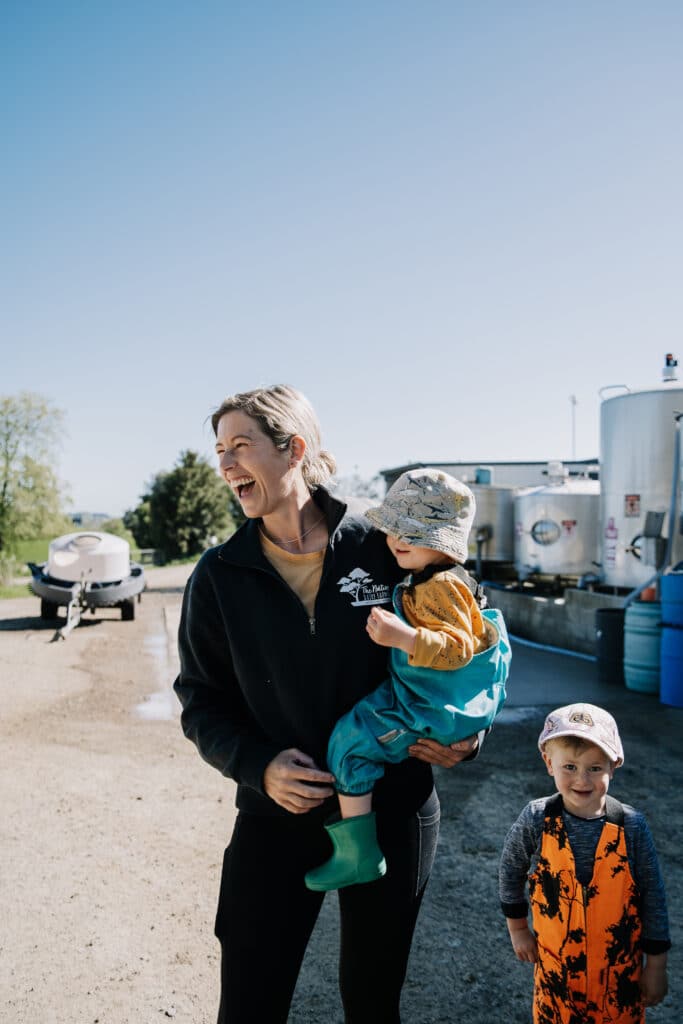
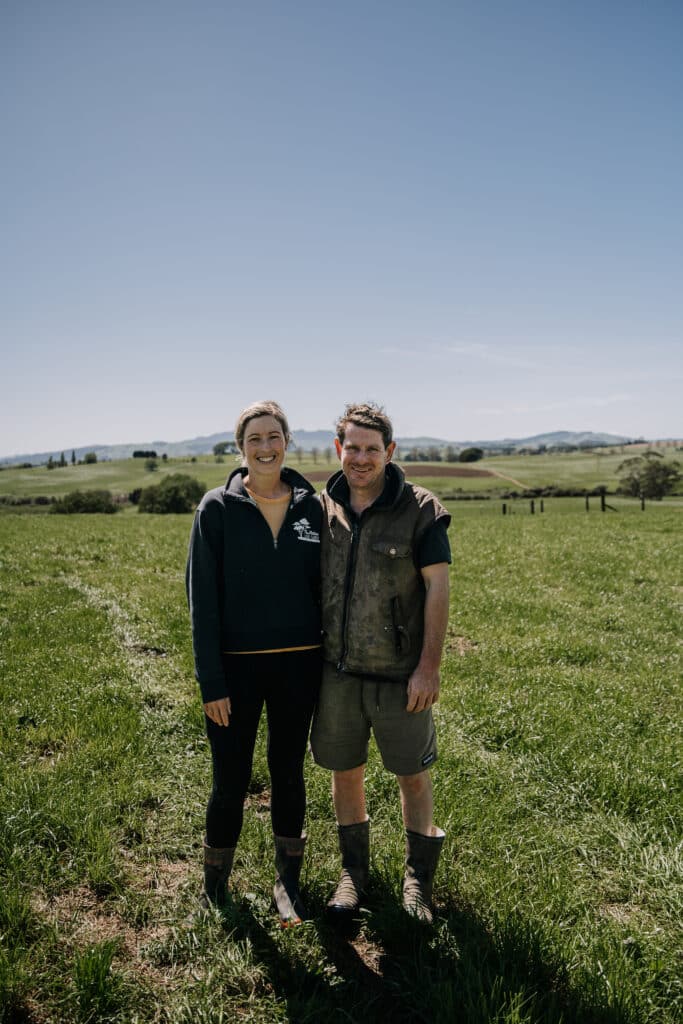
Left. “While I grew up on a sheep and beef farm, to be honest, I never thought I would see myself as a dairy farmer. And now you’ll find me in the cowshed or down feeding calves – I love it,” says Alice.
Right. “I think that we’re a good balance for each other,” says Alice. “We notice when one person’s struggling or having a bad day. One of us might just walk down to the cowshed with a coffee or a muesli bar or something little like that – we tend to pick up when the other one needs a pick-me-up. We work well as a team in that respect.”
Walter and Rex, who has just turned two, are typical farm kids. “We’ve probably created a bit of a monster,” Alice laughs. “At the moment they’re both sick and I’m struggling to keep them indoors because all they want is to ‘go down the farm, Mum!’ They’re at the window as soon as they hear a tractor or quad bike. The other day Walter turned to me and said, ‘Mum, what a cool tree.’ For me, that’s everything. Even if it’s been a tough day, or if there’s spilled potting mix, or the boys have pulled plants out of pots, moments like that make it all worth it.”
ASB is backing the food and fibre industry for the long haul. Whether you’re looking to diversify your land, install solar and improve energy resilience, or start your succession journey, talk to ASB’s dedicated team about how they can help you get one step ahead. T&Cs apply, see asb.co.nz/food-and-fibre for more information.
If you enjoyed this story, please share with someone else.
This story appeared in the Raumati Summer 2025/26 Edition of Shepherdess.
Get your hands on a copy.
Related Stories

The Old Way Sweet Scrolls Recipe
Super easy, soft and delicious, these sweet scrolls can be rolled up with whatever flavour combinations you fancy!
Sally Dryland
This story is the second in a series where we share, in their own words, the stories of ten women who call Tararua home.
Doing it for the kids: making the local marae clubrooms a community-positive, whānau-focused space
Stacey lives next to Hungahungatoroa Marae, where she has shifted the priorities and focus of the clubroom to provide a more wholesome and community-positive space.
Championing the rural sector every step of the way
Rebecca Greaves, 38, is a rural journalist based in Pongaroa. She is a tireless champion of rural communities.